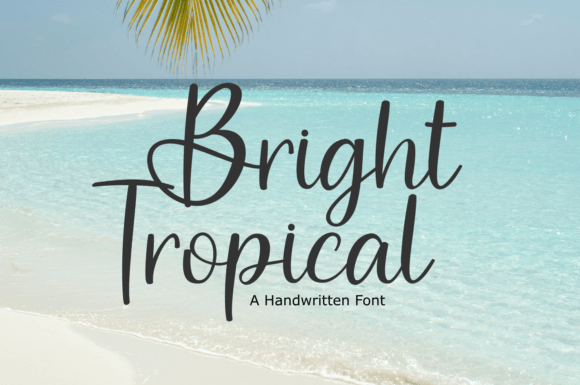
Bright Tropical: A Handwritten Font with Charm
There’s something quietly powerful about a font that feels handmade—not overly polished, not artificially “perfect,” but warm, intentional, and full of quiet personality. Bright Tropical is exactly that: a cute and simple handwritten typeface designed to bring authenticity to your visual communication. It’s not flashy or dramatic—it’s approachable, legible, and grounded in the tactile feel of chalk on slate or ink on paper. That makes it especially valuable for creators who want their work to feel personal without sacrificing clarity.
What sets Bright Tropical apart isn’t just its friendly curves or relaxed rhythm—it’s how thoughtfully it’s built for real-world use. The font is PUA-encoded, meaning every alternate glyph, swash, and stylistic variation is accessible directly through your design software—no complex OpenType panels or workarounds required. You don’t need advanced typography knowledge to unlock its expressive potential. Just install, select, and start designing with intention.
Where Bright Tropical Fits Naturally
This font shines where warmth and human touch matter most—especially in educational, lifestyle, and small-business contexts. Think classroom posters, workshop handouts, boutique packaging labels, Instagram quote graphics, or even printed recipe cards for a food blog. Its authentic look helps soften digital content, making it feel less transactional and more relational.
For educators, Bright Tropical adds gentle energy to lesson plans, vocabulary lists, or student-facing instructions—without overwhelming young readers. Its open letterforms support readability, while its subtle irregularities keep things visually engaging. A kindergarten teacher might use it for daily schedule boards; a university instructor could apply it to discussion prompts or reflection sheets where tone matters as much as content.
Marketers and small business owners find it useful for brand voice alignment—particularly in wellness, education, parenting, or creative services. If your brand values sincerity over slickness, Bright Tropical supports that stance without needing explanation. A yoga studio’s seasonal newsletter, a freelance illustrator’s pricing guide, or a local bakery’s weekly special board all gain cohesion and charm when set in this font.
Creative Uses Beyond the Obvious
Don’t limit Bright Tropical to headlines or quotes. Try layering it intentionally:
- Pair it with a clean, neutral sans-serif (like Inter or Lato) for contrast—use Bright Tropical for callouts or emotional emphasis, and the sans-serif for body text or data.
- Use its swashes selectively—not on every word, but to highlight key verbs (“grow,” “create,” “learn”) or nouns (“community,” “joy,” “home”).
- Apply light tracking (+10 to +20) for airy, breezy headings—ideal for summer campaigns or wellness themes.
- Print it on textured paper or use it in mockups with chalkboard or kraft paper backgrounds to reinforce its tactile roots.
One practical tip: avoid using Bright Tropical at very small sizes (under 14pt) for body copy. Its charm lives in its slight imperfections—and those details get lost when scaled down. Reserve it for display text, short phrases, or medium-sized captions where its character has room to breathe.
Consistency Without Repetition
Using a handwritten font across multiple assets can risk looking haphazard—unless you establish simple rules. With Bright Tropical, define two or three consistent applications upfront:
- Headings only: Use it exclusively for titles, section breaks, and featured quotes.
- Accent words only: Keep body text in a neutral font and swap in Bright Tropical for one or two strategic words per paragraph—like highlighting an action verb or core value.
- Chalkboard-style layouts only: Reserve it for materials that mimic physical media—classroom posters, workshop worksheets, or printed event signage.
This kind of restraint keeps your work feeling intentional rather than scattered. It also helps your audience subconsciously associate the font with specific moments—making those moments more memorable.
Real Projects, Real Results
A homeschooling parent created a weekly “Learning Loop” chart for her children using Bright Tropical for activity names (“Read Aloud,” “Nature Walk,” “Sketch Time”) and paired it with simple icons. The result felt inviting—not like a rigid schedule, but like a shared plan drawn together.
A community garden group used the font on reusable chalkboard signs marking plant varieties and care tips. Because Bright Tropical mimics natural handwriting, visitors assumed the signs were updated by volunteers—not pre-printed. That perception strengthened trust and connection.
A freelance educator redesigned her course workbook covers with Bright Tropical for titles and subtle swashes for chapter dividers. Students reported the materials felt “more like a conversation than a lecture”—a direct effect of typography supporting tone.
Getting Started Thoughtfully
If you’re new to Bright Tropical, begin with one low-stakes project: a printable checklist, a social media quote graphic, or a simple classroom poster. Focus on legibility first—test how it looks on screen and in print. Adjust line height and letter spacing until it feels balanced, not cramped or too loose.
When sharing files with collaborators or clients, embed the font or provide clear usage guidelines—especially if they’ll be editing text. Since Bright Tropical includes PUA-encoded extras, make sure others know how to access alternates (usually via Glyphs panel in Illustrator or Font Book in Affinity apps).
And remember: fonts don’t carry meaning on their own—they amplify what’s already there. Bright Tropical won’t fix weak messaging or unclear goals. But when paired with thoughtful content and purposeful design, it helps your ideas land with sincerity and warmth.
It’s not about making everything look “cute.” It’s about choosing tools that align with how you want people to feel when they see your work—seen, welcomed, encouraged. That’s where Bright Tropical earns its place—not as decoration, but as quiet, consistent support for meaningful communication.