Hello Hellen: A Handwritten Font That Fits Real Creative Workflows
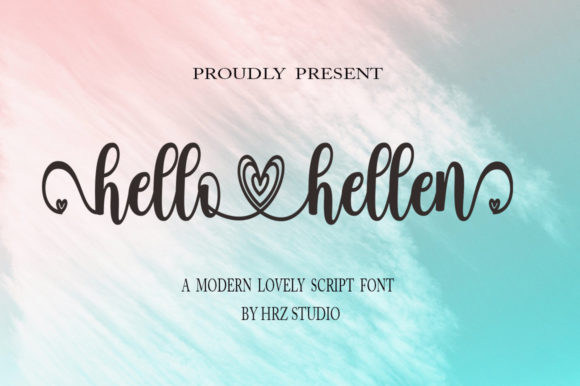
Hello Hellen is more than a stylish handwritten font—it’s a precision-crafted tool designed for people who value both aesthetic integrity and functional reliability. Whether you’re drafting a brand identity, designing a workshop handout, preparing a pitch deck, or building a course landing page, Hello Hellen delivers expressive warmth without sacrificing clarity or control. Its distinct letterforms—slightly tapered, rhythmically spaced, and rich in organic variation—carry personality while remaining legible at scale. That balance isn’t accidental. It’s the result of intentional design decisions that serve actual use cases, not just visual trends.
Where Hello Hellen Fits in Your Creative Process
Fonts aren’t isolated assets—they’re part of a chain: research → concept → layout → refinement → delivery. Hello Hellen operates most effectively in the *concept* and *refinement* stages, especially when authenticity, approachability, or human-centered messaging matters. For example, educators developing learning materials often test multiple typefaces to see which supports comprehension *and* emotional resonance. Hello Hellen frequently wins that test—not because it’s “cute” or “trendy,” but because its natural stroke modulation helps guide the eye through longer passages without fatigue.
Marketers launching a new service might use Hello Hellen early in mood board development to signal tone before committing to full mockups. Its PUA (Private Use Area) encoding means every alternate character, ligature, and swash is accessible directly from your keyboard—no need to hunt through glyph panels or switch applications. That saves time during iterative phases where rapid visual testing is essential.
Integration With Common Tools and Platforms
Hello Hellen works natively in Adobe Creative Cloud apps (Illustrator, Photoshop, InDesign), Affinity Designer, Figma (via desktop app with local font install), and Canva (when uploaded as a custom font). It’s also compatible with Microsoft Office on Windows and macOS, though advanced OpenType features like contextual alternates require manual glyph selection outside professional design software.
For freelancers managing client files across platforms, consistency matters. If you deliver layered PSDs or INDD packages, embed Hello Hellen—or provide a clear font license note for handoff. Small business owners using Shopify or Squarespace can upload Hello Hellen as a web font via @font-face (with proper licensing), ensuring branded headlines retain their distinctive voice on live sites. Just remember: web use requires a separate license tier, and self-hosting gives you more control over loading performance and fallback behavior.
Practical Implementation Tips
- Start with hierarchy, not decoration. Use Hello Hellen for headings, quotes, or short callouts—not body text in long-form web content. Pair it with a clean sans-serif (like Inter, Lato, or Montserrat) for contrast and readability.
- Leverage PUA encoding intentionally. Instead of applying swashes randomly, assign them purpose: use the flourish-l ending on “Hello” in a welcome banner; choose the high-arched “g” for logo lockups where vertical space allows. Keep a quick-reference PDF of glyphs open while designing—it cuts decision fatigue.
- Test spacing rigorously. Handwritten fonts can tighten or loosen unpredictably between letters. Adjust tracking manually in headlines—especially at larger sizes—to avoid unintended collisions or gaps. A +10–+25 tracking value often improves rhythm without losing character.
- Consider color contrast for accessibility. Hello Hellen’s fine strokes perform best against solid, high-contrast backgrounds. Avoid light gray text on white or thin weight usage below 24px in digital interfaces. Run quick WCAG checks using browser extensions like axe or Stark.
Workflow Examples Across Roles
For bloggers and content creators: Use Hello Hellen in featured image headers, email newsletter banners, and Pinterest pins. Its uniqueness helps your visuals stand out in crowded feeds—without requiring illustration skills. Because it’s PUA-encoded, you can build reusable Canva templates with preset swash combinations, cutting production time per post from 20 minutes to under 5.
For educators and trainers: Integrate Hello Hellen into slide decks for section titles and key takeaways. The font’s gentle irregularity supports cognitive engagement—studies suggest moderate visual variation increases retention in learning contexts. Export slides as PDFs with fonts embedded so formatting stays intact across devices during workshops.
For small business owners: Apply Hello Hellen consistently across three touchpoints: storefront signage (cut vinyl or printed banners), packaging labels (in Illustrator with outlined text for print safety), and Instagram Story highlights (using native text tools with uploaded font). This creates cohesive recognition without needing a full branding agency.
Long-Term Usability and Quality Control
Because Hello Hellen includes extensive language support—including Latin Extended-A and common diacritics—it scales reliably across multilingual projects. If you regularly create content for Spanish-, French-, or German-speaking audiences, verify that accented characters (like “ñ”, “é”, “ü”) render correctly in your target environment before finalizing layouts.
Organize your font library thoughtfully. Rename the file clearly (e.g., “HelloHellen-Regular-PUA.otf”) and store it in a project-specific /fonts folder alongside license documentation. This prevents version confusion—especially when collaborating or revisiting work months later. Also, keep a dated backup of the original download; font updates occasionally adjust spacing or add glyphs, and reproducibility matters for brand audits or legal compliance.
Efficiency compounds over time. Once you’ve built a set of Hello Hellen–based templates—email headers, social post frames, presentation masters—you’ll notice faster turnaround on repeat tasks. More importantly, the font becomes part of your visual vocabulary, reducing the mental load of “what should this feel like?” before each new project.
When Hello Hellen Isn’t the Right Choice
It’s worth acknowledging limits. Hello Hellen isn’t optimized for data tables, code comments, or interface microcopy. Its charm lies in intentionality—not ubiquity. If your workflow involves frequent editing by non-designers (e.g., team members updating CMS content), stick with system-safe fonts for body copy and reserve Hello Hellen for static, high-impact elements you control directly.
Also consider context: a law firm’s official letterhead may benefit more from typographic gravitas than handwritten warmth. Hello Hellen shines where human connection is the goal—not authority, urgency, or technical precision alone. Knowing when *not* to use it is part of using it well.
Getting Started Without Overcomplicating Things
You don’t need to redesign everything at once. Pick one recurring asset—a monthly newsletter header, a workshop worksheet title, or your LinkedIn banner—and replace the current font with Hello Hellen. Use the PUA characters to swap in a single swash or alternate “a” or “y”. Notice how it changes tone. Then ask: does this align with the message I want to convey? Does it feel easier to produce next time? If yes, expand gradually.
No tool transforms output without deliberate integration. Hello Hellen supports clarity, warmth, and distinction—but only when matched to purpose, tested in context, and maintained with consistency. That’s not a limitation. It’s what makes it reliable.